 Cryptocom
Cryptocom card fees depend on card type, funding methods, ATM allowances, and regional terms
Last updated ·
Cryptocom card fees differ between prepaid cards and the US Visa Signature credit card. Prepaid charges vary with the program, funding method, card tier, and transaction currency. Loading money with another payment card can incur a top-up charge. Cash withdrawals can attract fees after the monthly free allowance, plus an ATM operator surcharge. Foreign transaction, physical issuance, inactivity, and account closure charges follow separate regional terms.
In this guide
The money available for card spending differs from crypto held in the App. Funding charges arise when money enters the prepaid balance; withdrawal and foreign transaction charges arise when the card accesses or spends that balance.
Key takeaway: A free ATM allowance covers the card program's withdrawal fee, while operator surcharges and foreign transaction charges can still apply.
Funding charges and withdrawal fees apply at different points
A top-up fee applies when you fund the card, while an ATM fee applies when you withdraw cash from its balance. Paying one does not remove the other. The United States prepaid Visa schedule dated 1 September 2026 lists these parameters. Its ATM percentage applies only to amounts above the relevant monthly free allowance.
| Fee parameter | Listed value | Applicable funding or withdrawal |
|---|---|---|
| Debit card top-up | 1% of the top-up amount | US prepaid Visa funding with a debit card |
| Credit card top-up | 2.99% of the top-up amount | US prepaid Visa funding with a credit card |
| ATM excess withdrawal | 2% of the amount above the monthly free allowance | US prepaid Visa cash withdrawals |
How does the top-up method change the cost?
External payment cards use regional top-up rates, while cash and crypto funding involve different cost components. The prepaid balance holds spending currency. A charge for buying cryptocurrency belongs to that purchase; using the resulting crypto for card funding introduces a separate conversion.
Cash already held in the App
Cash Account funding moves an eligible fiat balance into the prepaid card. Fiat means government-issued currency. The US card uses USD, the Europe-resident card program uses EUR, and the UK card uses GBP. Depositing money into the Cash Account does not automatically load the prepaid balance. Method availability also follows the issued program. New Zealand residents holding Australia-issued cards cannot use the Australian Cash Account top-up method.
Crypto conversion
Manual crypto funding converts a supported Token Wallet balance into spending currency. The conversion rate determines how much crypto funds the selected card amount. An external wallet transfer can add network gas costs before card funding. Routes through Cronos or Cronos zkEVM may swap eligible tokens into USDC or ETH before cash conversion. Additional swap fees and slippage can apply when that conversion requires a swap. Slippage is the difference between the expected and executed swap price. These blockchain costs belong to the external-wallet route; a top-up using crypto already in the App does not itself require that external transfer.
External payment methods
Debit and credit cards
European and UK prepaid cards charge 1% for debit or credit card top-ups. Australia charges 1% for debit card top-ups entered directly and 2% for credit card top-ups. Singapore-issued cards charge 0% for debit card top-ups entered directly and 1% for credit card top-ups. The bank issuing the funding card can also levy its own charges. A prepaid top-up rate describes the card program's charge, without settling the funding bank's separate pricing.
PayPal and Apple Pay
PayPal top-ups cost 2.1% for eligible US prepaid Visa accounts. Apple Pay funding has its own method-specific rate in some programs. Australia and Singapore charge 2% for debit or credit card top-ups through Apple Pay. That means the mobile payment route can carry a different charge from entering the same funding card directly.
ATM allowances, cash limits, and machine surcharges
A monthly free ATM allowance waives the card program's withdrawal fee up to its threshold. Daily cash limits still restrict withdrawals.
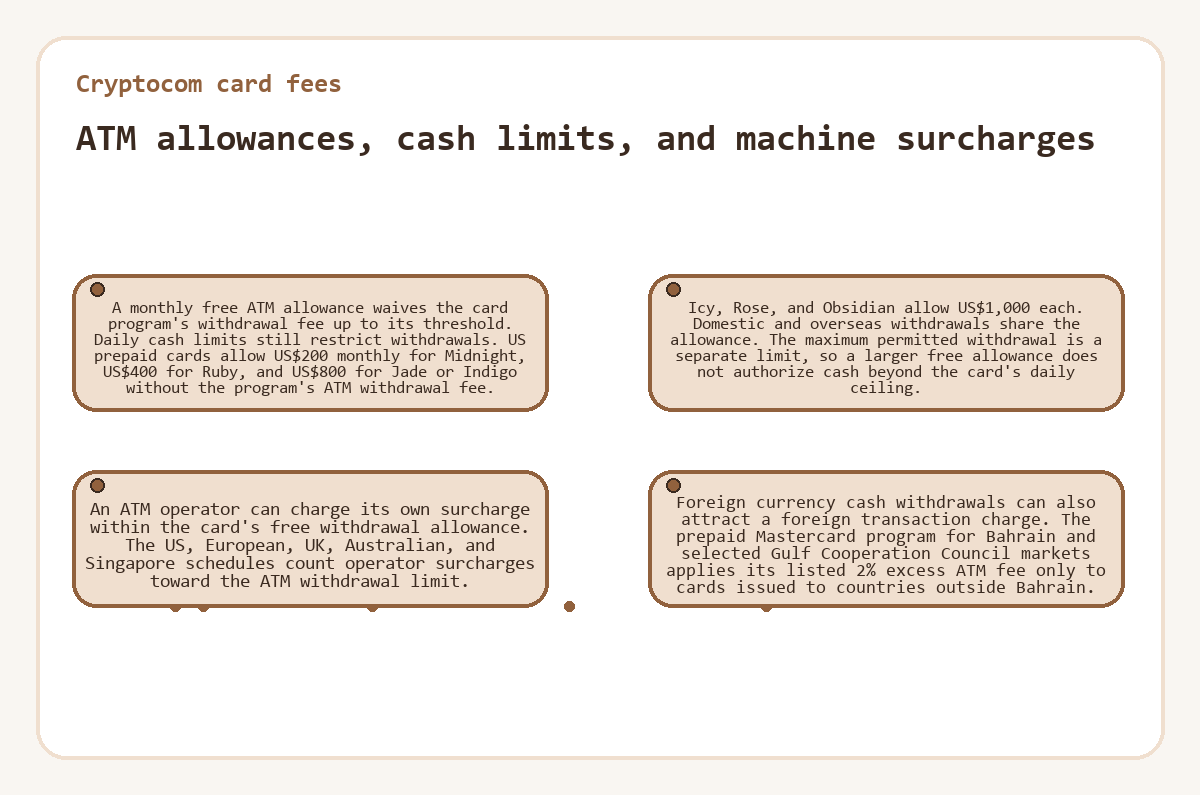
US prepaid cards allow US$200 monthly for Midnight, US$400 for Ruby, and US$800 for Jade or Indigo without the program's ATM withdrawal fee. Icy, Rose, and Obsidian allow US$1,000 each. Domestic and overseas withdrawals share the allowance. The maximum permitted withdrawal is a separate limit, so a larger free allowance does not authorize cash beyond the card's daily ceiling.
An ATM operator can charge its own surcharge within the card's free withdrawal allowance. The US, European, UK, Australian, and Singapore schedules count operator surcharges toward the ATM withdrawal limit. Foreign currency cash withdrawals can also attract a foreign transaction charge. The prepaid Mastercard program for Bahrain and selected Gulf Cooperation Council markets applies its listed 2% excess ATM fee only to cards issued to countries outside Bahrain.
What changes the cost of a foreign currency transaction?
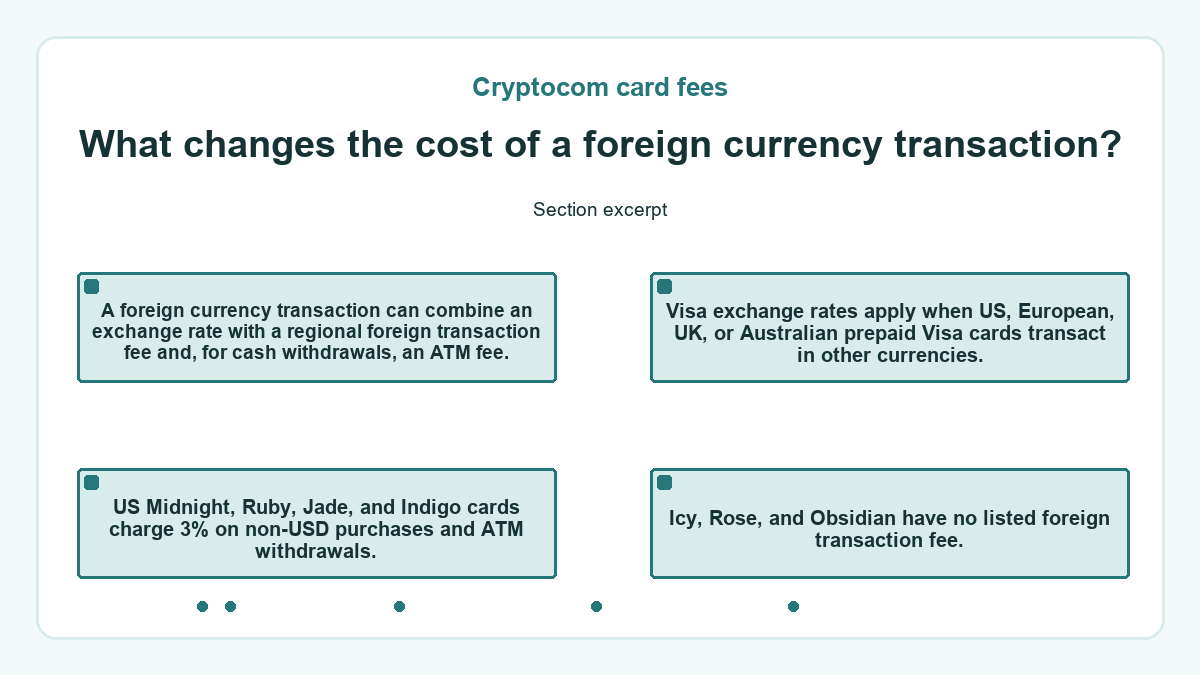
A foreign currency transaction can combine an exchange rate with a regional foreign transaction fee and, for cash withdrawals, an ATM fee. Visa exchange rates apply when US, European, UK, or Australian prepaid Visa cards transact in other currencies. US Midnight, Ruby, Jade, and Indigo cards charge 3% on non-USD purchases and ATM withdrawals. Icy, Rose, and Obsidian have no listed foreign transaction fee.
From 1 October 2026, the Europe-resident and UK prepaid programs charge Midnight, Ruby, Jade, and Indigo 0.2% on foreign currency purchases and ATM transactions within the EU and UK. Outside those areas, Midnight charges 2%. Ruby has a fee-free allowance of EUR 400 or GBP 400 per calendar month, followed by 2%. Jade and Indigo have EUR 800 or GBP 800 allowances per calendar month, followed by 2%. These rules cover non-EUR purchases and ATM transactions for European cards, and non-GBP transactions for UK cards. Icy, Rose, and Obsidian have no listed foreign transaction fee.
Canada uses a foreign currency administration fee for non-CAD purchases and ATM withdrawals. From 1 September 2026, Ruby allows CAD 700 per calendar month before charging 2%. Jade and Indigo allow CAD 1,400 before the same rate applies. Midnight charges 2%, while Icy, Rose, and Obsidian have no listed foreign currency administration fee. This foreign currency allowance measures different activity from a free ATM withdrawal allowance.
Physical cards, inactivity, and closure bring separate charges
Physical issuance and replacement have separate prices. Europe-resident and UK Midnight issuance costs €4.99 or £4.99. Ruby costs €24.99 or £24.99 for Level Up Plus monthly subscribers with fewer than six consecutive subscription months. Ruby issuance is free for annual subscribers, monthly subscribers with at least six consecutive months, or users with an active Level Up lockup or stake. Replacement costs €45.01 or £45.01 for Midnight and €50 or £50 for other tiers. A waived upgrade charge does not erase these separate issuance conditions.
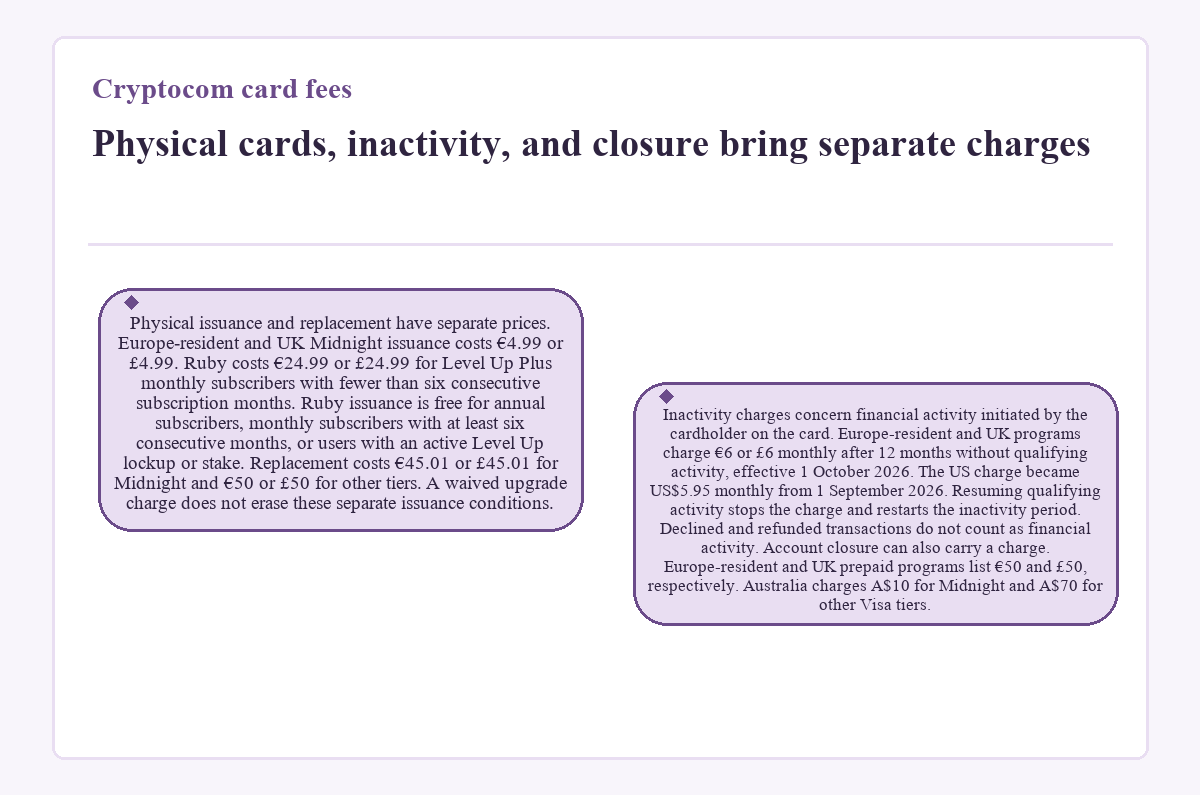
Inactivity charges concern financial activity initiated by the cardholder on the card. Europe-resident and UK programs charge €6 or £6 monthly after 12 months without qualifying activity, effective 1 October 2026. The US charge became US$5.95 monthly from 1 September 2026. Resuming qualifying activity stops the charge and restarts the inactivity period. Declined and refunded transactions do not count as financial activity.
Account closure can also carry a charge. Europe-resident and UK prepaid programs list €50 and £50, respectively. Australia charges A$10 for Midnight and A$70 for other Visa tiers.
The applicable schedule follows the issued card
The App's Settings menu includes Fees & Limits for the applicable prepaid card program and tier. Singapore separates resident and non-resident schedules. Bahrain and selected GCC markets use a prepaid Mastercard program. European-issued cards serving Brazil and selected Latin American markets also have a separate schedule. The US Visa Signature credit card uses a line of credit under a separate Comenity Capital Bank agreement. Its October 2026 rate and fee summary lists no annual fee and a 3% foreign transaction fee on the transaction's US-dollar value. Each balance transfer or cash advance costs US$10 or 5% of the amount, whichever is greater. Missing a minimum payment by its due date or making a payment the bank does not honor can trigger fees of up to US$41 each. Purchase and balance-transfer APRs are 17.49%, 25.49%, or 31.49%, depending on creditworthiness; the cash-advance APR is 32.49%. These rates vary with the Prime Rate. Cash advances and balance transfers accrue interest from the transaction date. While the purchase grace period is active, full repayment by the monthly due date avoids purchase interest. Regaining a lost grace period requires two consecutive billing periods of full, timely repayment. If interest is charged, the minimum is US$3. Late payments can also trigger a variable penalty APR up to 39.99%. Using the schedule attached to your card prevents a top-up or withdrawal estimate from borrowing another program's allowance.
Everyday questions about Cryptocom card fees
Why does a pending card payment exceed the amount on my receipt?
A merchant preauthorization can temporarily reserve more money than the final purchase costs. Hotels, car rental companies, fuel stations, and some restaurants use these holds to cover a possible final charge. The reserved amount reduces the available prepaid balance until settlement. Any excess is released when the transaction settles; the temporary hold is distinct from a card fee.
Can unused prepaid funds return to the App's Cash Account?
Prepaid Visa cards under the US, Europe-resident, UK, and Australian programs do not support transferring a completed top-up back to the Cash Account. Spending and permitted ATM withdrawals access the loaded card balance under their own terms. A bank withdrawal from the Cash Account uses money held there, so it does not withdraw funds already loaded onto the prepaid card.
When does the monthly free ATM allowance reset?
Monthly US card limits reset at 00:00 EST on the first day of each calendar month. European and UK monthly card limits reset at 00:00 GMT on that day. Aggregated loading limits use a rolling basis instead, so a top-up limit and the monthly ATM allowance can follow different reset rules.
Does Auto Top-up remove the card's funding limits?
Auto Top-up has its own daily limit and still obeys the card's maximum balance and load-frequency rules. After reaching the daily Auto Top-up limit, you can still fund the card manually within its existing limits. A frozen card or insufficient funds in the chosen Token Wallet balance can prevent automatic funding, even when the relevant currency balance falls below the configured threshold. On Singapore, EUR-denominated European, and UK cards, that threshold uses the SGD, EUR, or GBP balance, respectively.
Are cash withdrawals available inside Singapore?
Singapore-issued prepaid Visa cards support ATM withdrawals outside Singapore, not at domestic ATMs. Separate schedules govern Singapore residents and holders with non-Singapore residential addresses. Their overseas withdrawal ceilings differ, and a free monthly ATM allowance does not remove those ceilings or any applicable operator and foreign transaction charges.
Is there an annual fee for the prepaid card itself?
The prepaid card itself has no standard annual or monthly maintenance fee. A paid Level Up subscription can carry a separate monthly or annual charge for its plan benefits. Physical card issuance, replacements, transaction charges, and inactivity fees remain separate costs, so the absence of an annual card fee does not make every card service free.
Will ending a Level Up subscription remove the card's free ATM allowance?
The existing prepaid card retains the free ATM allowance associated with its card tier after a Level Up subscription ends. The program reserves the right to change, suspend, or end these benefits immediately when subscription payments stop. The plan changes to Basic when cancellation takes effect at the end of the billing cycle. At renewal, the reissued card tier corresponds to the Level Up plan, so its ATM allowance can change when the replacement belongs to a different tier.